
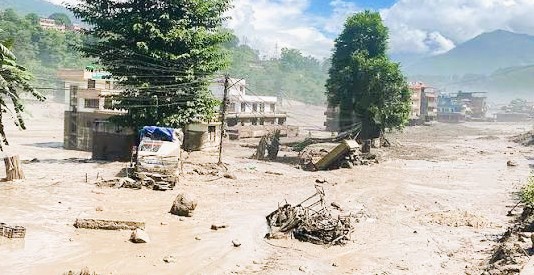
The Nepal government is preparing to create temporary housing for families displaced by the severe Bhotekoshi-Trishuli floods on August 26. Approximately 400 to 500 families have been identified as needing immediate accommodation.
The National Disaster Risk Reduction and Management Authority (NDRRMA) is inviting non-governmental and partner organizations to submit proposals for constructing these temporary homes.
Organizations must detail the number of homes, construction sites, local government involvement, and project timelines. Those with existing agreements for temporary housing must share the specifics of these arrangements.
Ensuring Safety in Temporary Housing
The proposed homes will be developed in collaboration with the Department of Urban Development and Building Construction and local governments.
Deputy Director General Prakash Aryal stated that proposals will be evaluated based on basic building codes. Designs that meet safety standards will be approved prior to construction.
Authorities have noted that a single design cannot be used for all flood-affected areas due to varying geographical and environmental conditions. The government will assess the suitability of proposed structures for each specific location.
The plan includes constructing two-room temporary houses, each about 320 square feet, for the families.
Identifying Safe Locations
Authorities will first pinpoint suitable sites for temporary settlements. Local governments will select potential locations from those identified by the government, and geological experts will evaluate their safety.
Once approved, the Ministry of Physical Infrastructure Development will coordinate with district administrations, NDRRMA, and partner organizations to establish the temporary settlements.
These settlements are expected to include essential infrastructure such as roads, electricity, drinking water, sanitation, and communication facilities.
Initial Identification of Families in Need
A survey by the Department of Urban Development and Building Construction, in collaboration with local governments, indicated that around 400 to 500 families may initially require temporary housing.
Some families are currently living in rented spaces, while others are staying with relatives. Authorities suggest that the number of families needing temporary housing may rise as the rehabilitation program continues.
The government will also offer accommodation and livelihood support to those who prefer not to stay in holding centers for up to six months until alternative housing is arranged.
Families of up to four members will receive Rs 15,000 per month, and families with more than four members will receive an additional Rs 2,000 per person.
Cost of Temporary Homes
The Department of Urban Development and Building Construction estimates that the cost of a temporary home could range from Rs 200,000 to Rs 500,000, depending on the design, location, and available budget.
While the government has approved model designs as references, construction will not follow a single design for all affected areas.
The flood disaster has impacted 32,936 individuals, affected 8,317 households, and damaged 7,570 private buildings, according to NDRRMA data.
While plans for permanent reconstruction are underway, the government is prioritizing temporary housing to ensure safer accommodations for displaced families during the recovery period.