
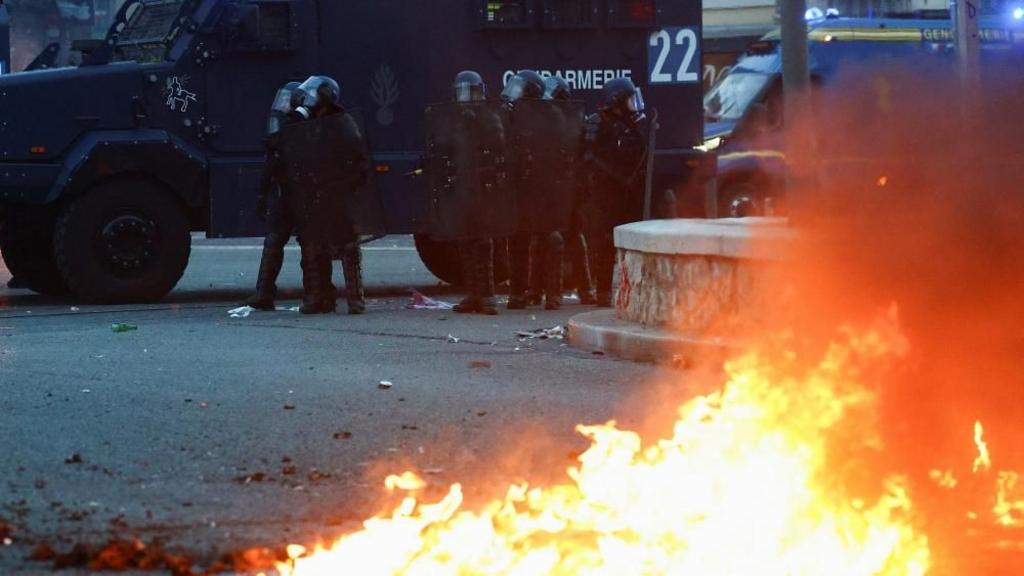
Nearly 1,000 people were detained during protests across France, following confrontations between demonstrators and police in Paris and other cities.
Interior Minister Laurent Nuñez said the arrest total could climb as authorities receive further reports. Police used tear gas and water cannon in several places.
According to the Interior Ministry, nearly 410,000 people took part in demonstrations nationwide. The CGT trade union put the turnout at close to 800,000.
About 70,000 police officers and gendarmes were deployed around the country to prevent a repeat of the widespread looting, vandalism and clashes seen during the previous weekend’s protests.
Clashes in the closing stages of Paris demonstration
Police estimated that around 110,000 people joined the main march in the capital. It began peacefully, with demonstrators following a route through southeastern Paris.
Near the end, however, some people wearing masks began hurling objects and fireworks. Police used tear gas and water cannon to break up the crowds.
Authorities redirected the approved route away from central Paris because they feared another demonstration could cause serious property damage.
Police conducted more than 3,000 identity and security checks in Paris. Arrests made in the capital are included in the nationwide total.
Violence in cities across France
Paris was not the only city affected. Protesters and police clashed in Lyon, Lille, Marseille, Montpellier, Nantes and Toulouse.
Tear gas was deployed in several locations, and water cannon were used in some cases. In Lyon, police confronted a group attempting to block a road near the city centre.
In Marseille, groups of young people clashed with police. Other demonstrations passed without incident.
On the whole, violence was less widespread than the previous weekend, when looting and fires caused damage to businesses and public buildings.
Why are people protesting?
The protests first involved students and school groups raising concerns about staffing shortages, poor conditions and inadequate resources in schools. They have since expanded into a broader movement, with workers and trade unions joining calls for action on living costs and inequality.
Demonstrators want more teachers, better school facilities, additional university places and increased financial support for students. They are also calling for higher wages, improved public services and less strain on household budgets.
As the cost of essentials and housing continues to rise, public frustration is growing. Protesters have also criticised President Emmanuel Macron’s government for failing to address economic pressures.
The demonstrations have become an expression of discontent among students, workers, trade unions and others who believe economic insecurity and inequality are worsening.
70,000 police and gendarmes deployed
Nearly 70,000 police officers and gendarmes were deployed nationwide 10,000 more than during the previous round of protests.
Specialist police units were brought in, and additional security measures were introduced to protect public buildings, shops and key areas.
Demonstrations were restricted in several locations, while others were permitted under certain conditions. Many businesses closed or covered their windows as a precaution. Some Paris public transport services were also disrupted.
The government said the increased police presence was necessary to respond swiftly to violence and limit damage. Some unions and organisations, however, condemned restrictions on demonstration routes.
Pressure on Macron’s government
The demonstrations have added to the pressure on Macron’s government as the next presidential election, scheduled for May 2027, approaches.
Ministers must respond to public demands concerning education, living costs and public services while also maintaining order across the country.
Some opposition figures have accused the government of ignoring people’s economic concerns. Others have focused on its efforts to protect the public and ensure those responsible for violence and vandalism are held accountable.
The latest protests have developed into a social movement and a test for the government.
Arrests rise
Nuñez said nearly 1,000 people were arrested during Saturday’s protests. The figure may increase as police reports are received.
Although a number of smaller confrontations took place, many demonstrations proceeded peacefully. Turnout was high, though estimates from the Interior Ministry and trade unions differed considerably.
Authorities will continue assessing the number of arrests, the extent of the damage and the way security was managed.
The demonstrations have highlighted the tension between demands for economic and social change and the need to maintain public order. It is unclear whether they will lead to policy changes, but concerns about education, inequality and the cost of living remain.