
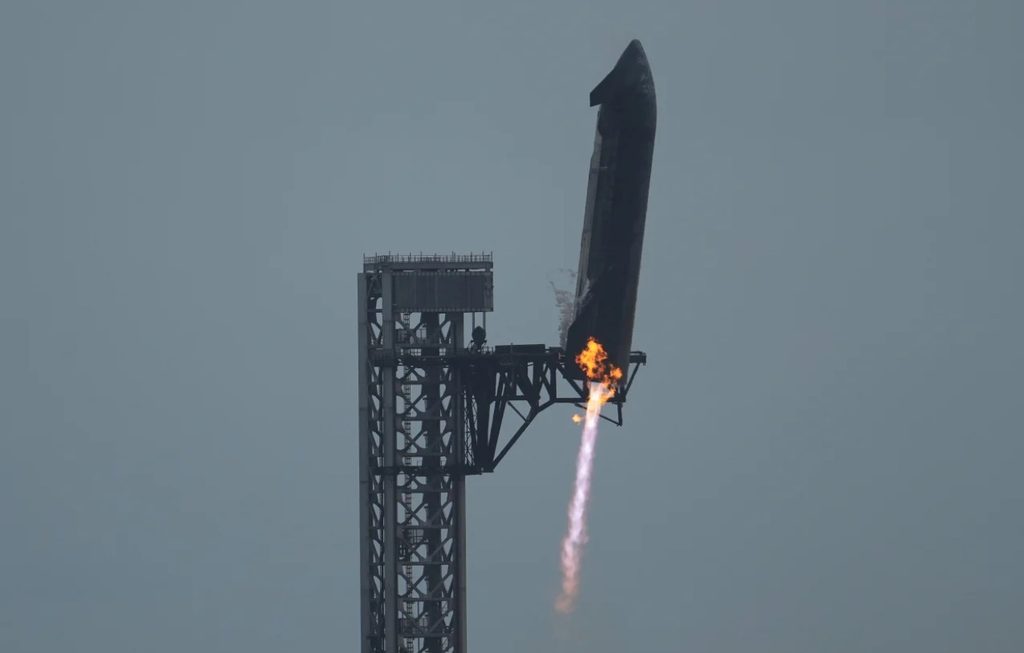
SpaceX has achieved a significant milestone as the Starship was successfully caught by the massive claw like arms of its launch tower.
This dramatic recovery took place at SpaceX’s Starbase in South Texas on Saturday (Nov 14), approximately 22 hours after its launch on Friday.
The Starship, also known as the upper stage, completed 14 orbits and was caught by the tower’s arms often called the ‘chopsticks.’ This marks the first time the craft has been caught during its return from orbit.
This event is a crucial step in SpaceX’s mission to develop a fully reusable rocket.
Starship Completes 22 Hour Earth Orbit
Starship Flight 15 launched on Friday (Nov 13).
After separating from the Super Heavy booster, the upper stage successfully entered Low Earth Orbit and deployed 26 next generation Starlink V3 satellites.
The spacecraft spent over 22 hours in space, completing around 14 orbits of Earth.
Upon returning, the craft maneuvered perfectly between the claw like arms of the launch tower.
Super Heavy Recovery Attempt Canceled
While the recovery of the spacecraft was successful, SpaceX could not complete their planned double recovery.
They aimed to catch both the Starship and the Super Heavy booster stage.
However, shortly after launch on Friday, the booster could not return to the tower and instead headed towards a designated landing zone in the Gulf of Mexico. Just before landing, the booster exploded.
It was confirmed that the boostback burn was shorter than expected due to running low on fuel too soon. The booster’s navigation systems recognized it was not in the correct position for recovery and automatically canceled the attempt.
SpaceX is investigating the cause of this issue.
Major Step Towards Fully Reusable Rockets
SpaceX is focused on making both the Starship and booster stages fully reusable.
They have successfully caught Super Heavy boosters with the tower’s arms before, but Flight 15 marked the first successful recovery of the upper Starship.
Achieving the ability to catch both stages will reduce launch costs and enable quicker turnaround for multiple missions.
Starship is essential to SpaceX’s future plans for transporting cargo and people to the Moon and Mars. NASA is also collaborating with SpaceX to develop Starship as a lunar lander for the Artemis program.
Although the failure to catch the booster was a setback, successfully recovering the spacecraft represents a major achievement.