
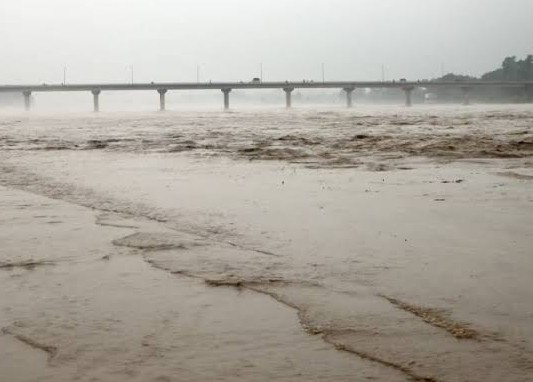
Intense monsoon rains have caused rivers and reservoirs in central Nepal to reach dangerous levels. On Sunday afternoon, the Narayani River hit a record high of 11.94 meters at Devghat, breaking previous records dating back to 1963.
Simultaneously, water levels in the Indrasarovar reservoir, which supports the Kulekhani Hydropower Project, have risen alarmingly. This has led authorities to close key routes between Hetauda and Kathmandu in anticipation of a possible need to open the spillway.
At Devghat, the Narayani River reached 11.94 meters at 2:10 PM on Sunday, as reported by the Department of Hydrology and Meteorology. This surpasses the river’s warning level of 7.30 meters and the danger level of 9.00 meters, outstripping the previous record of 11.60 meters set on October 12, 2024.
Sumit Adhikari, Chief Hydrologist at the Narayani Basin Field Office in Bharatpur, confirmed this as the highest level ever recorded at Devghat. Although it later fell slightly to 11.75 meters, officials remain worried as it is still above the danger threshold.
Fluctuations are expected with the continued rainfall in the upstream hilly areas. Residents in riverside communities such as Chitwan, Nawalparasi, and surrounding low-lying Terai regions are being advised to prepare for potential flooding.

In Makwanpur district, further south, the rising levels at Indrasarovar have prompted temporary closures of crucial roadways connecting Hetauda and Kathmandu.
The District Administration Office has halted vehicle traffic on shorter routes from 4:00 PM Sunday to 5:00 AM Monday.
Administrative Officer Santosh Subedi indicated that the Nepal Electricity Authority might soon initiate warning sirens and open the spillway gates of the Kulekhani Dam once all safety precautions are ensured.
Travelers and truck drivers are encouraged to use the Tribhuvan Highway between Kathmandu and Hetauda during this time for safety reasons. Local police are stationed along riverbanks downstream from the Kulekhani Dam to warn communities about potential water surges.