
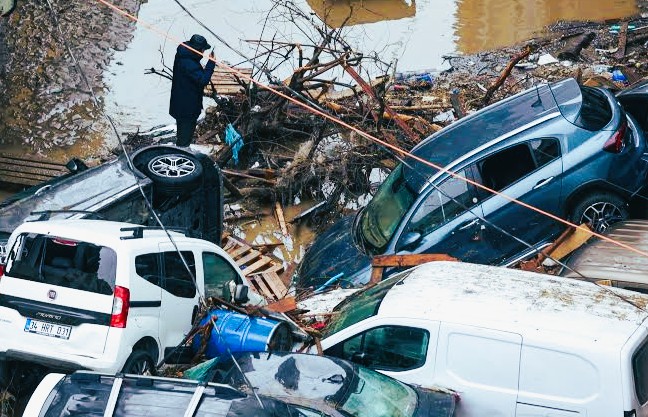
Intense downpours have flooded large parts of Istanbul, killing at least two people according to initial reports. Homes and businesses were inundated, vehicles swept away, and travel disrupted across Turkey’s largest city.
Istanbul Governor Davut Gül said the rainfall was the heaviest recorded in 84 years, based on records dating back to 1942.
The rain intensified on Wednesday, October 14, overwhelming the city’s drainage systems.
A 14-year-old boy died from electrocution after stepping into a puddle in Istanbul’s Fatih district. A 34-year-old man also died after slipping and striking his head while attempting to cross a flooded road.
As rescue efforts continued on Thursday, further reports put the death toll at three, while some Turkish media reported four fatalities by Thursday evening. The figures remain subject to change as officials search affected areas.
Homes, roads and businesses inundated
Extreme rainfall has caused flooding across Istanbul, a city of more than 16 million people.
Roads and underpasses have filled with water, while vehicles, homes and businesses have been submerged by the deluge.
Videos showed cars being carried along by fast-flowing, muddy water in several affected neighbourhoods, where residents were struggling to move around.
Some parts of the city suffered especially severe damage. Sections of road partially collapsed, and rivers and streams overflowed after the heavy rain.
The Istanbul Metropolitan Municipality reported exceptionally high rainfall in some districts. One report said Omerli in Beykoz, on the city’s Asian side, received nearly 194 millimetres, while another put the total as high as 242 millimetres.
Thousands deployed in rescue effort
Emergency services began a major operation to reach people trapped by the flooding.
Deputy Mayor Nuri Aslan initially said 595 people had been evacuated safely, with more than 8,000 municipal employees taking part in the emergency response.
Later, the Associated Press reported that Turkey’s interior minister said more than 2,700 people stranded by the floods had been rescued. The different totals reflect updates made as the response expanded.
Rescue teams continued to investigate reports of flooded properties, damaged roads and people trapped by rising water. Authorities were also examining the teenager’s death by electrocution.
Heavy rain prompted warnings in Istanbul and elsewhere in Turkey, where officials cautioned that further downpours could bring more flooding.
Schools shut as officials warn residents
The governor’s office closed schools and told residents to remain indoors if they needed to travel.
Officials urged people to keep away from flooded roads and underpasses, as well as riverbanks and stream channels, where water can rise rapidly.
People living in basement flats were advised to relocate to higher, safer areas because water could enter ground level and underground homes.
Authorities also restricted motorcycle travel to reduce danger on flooded roads. Leave arrangements were made for some public sector employees, while staff essential to health, safety and flood response remained on duty.
Officials said heavy rain might persist for several days and urged residents to follow emergency guidance and avoid nonessential trips.
Flights and other transport disrupted
The downpours caused major traffic problems, leaving roads and underpasses underwater and vehicles stranded around the city.
Air travel was affected too. Reports said dozens of aircraft were diverted or unable to land at Istanbul’s airports, while other flights were cancelled.
The disruption demonstrates how extreme rainfall can affect multiple parts of a major city’s transport network, restricting emergency access and disrupting journeys for residents and visitors.
Authorities are continuing to monitor road conditions and transport services while the rain persists.
Extreme weather fuels concern across Turkey
The flooding in Istanbul follows a year of unusually high rainfall and frequent extreme weather events in Turkey.
A report published in September found that rainfall from January through August was 54 per cent above the country’s 1991–2020 average. Heavy rain and flooding made up a substantial share of the extreme weather events recorded during the year’s first eight months.
The latest disaster has renewed concerns about urban drainage, flood readiness and the exposure of homes and infrastructure to intense rainfall.
Emergency workers are currently focused on helping those affected, assessing the damage and preventing further deaths as weather conditions remain unpredictable.
Authorities have urged Istanbul residents to heed warnings, stay clear of dangerous floodwater and follow official instructions until conditions improve.