
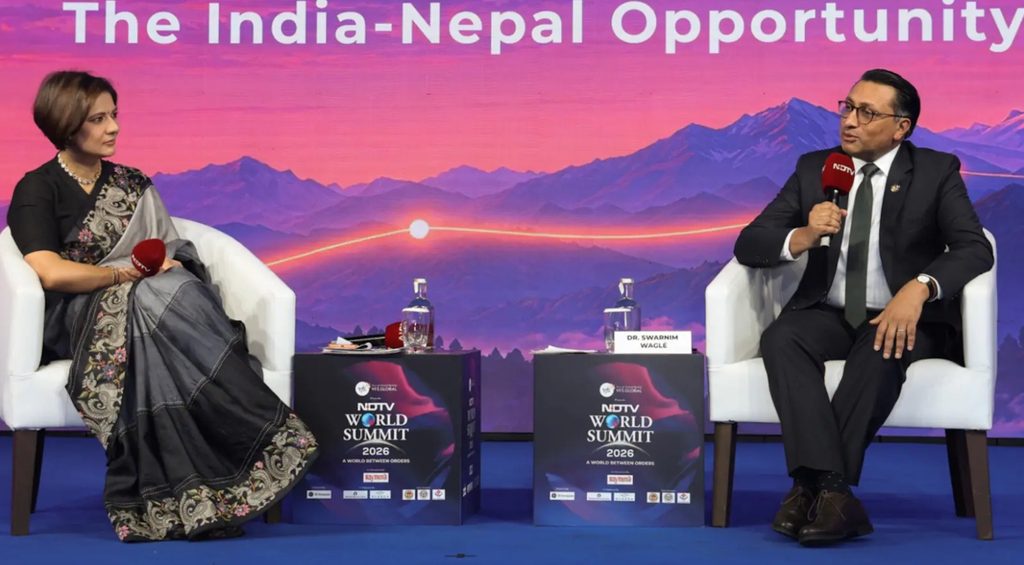
Nepal’s Finance Minister Dr. Swarnim Wagle has declared that the definition of Nepali nationalism no longer revolves around anti India feelings. He emphasized the importance of fostering stronger economic collaboration, good governance, and positive relations between Nepal and India.
At the NDTV World Summit 2026 in New Delhi, Wagle noted that younger generations in Nepal are prioritizing economic opportunities over the ideological divides that have shaped political discussions for years.
“Our goals are economic. We seek good jobs, effective governance, and strong neighborly relations,” Wagle stated.
He acknowledged that previous anti India sentiments in Nepali nationalism stemmed from long standing ideological conditioning but highlighted a shift towards a more constructive foreign policy and economic diplomacy.
Economic Prosperity is Nepal’s Main Focus
Wagle argued that the youth in Nepal aspire for jobs, economic growth, and enhanced public governance. He believes that the relationship with India should be seen through the lens of opportunities for Nepal, rather than historical political conflicts.
The finance minister pointed out that Nepal and India share economic interests, making cooperation vital for the prosperity of both nations.
He also mentioned that economic growth in neighboring countries can significantly benefit landlocked economies, noting that a 1% increase in a neighbor’s growth could yield about 0.7% growth for a landlocked country.
Wagle emphasized that closer economic ties with India are crucial for creating jobs, attracting investment, and expanding Nepal’s economy.
Nepal Aims for Increased Indian Investment and Market Access
Wagle expressed Nepal’s desire for greater foreign direct investment from India and easier access for Nepali products in the Indian market.
Better market access can help Nepali businesses reach more consumers, while increased investment can support production, employment, and economic development.
He stressed that Nepal-India relations should extend beyond geography and historical ties, focusing instead on tangible economic benefits.
These remarks reflect the government’s commitment to enhancing trade and investment cooperation with India while pursuing Nepal’s economic goals.
Prime Minister’s Visit to India Anticipated Before Year End
In his speech, Wagle indicated that he expects Nepal’s prime minister to visit India before the end of 2026 to strengthen bilateral ties.
If the visit occurs as anticipated, it could provide an opportunity for both governments to discuss investment, market access, and other areas of economic collaboration.
Wagle described the future of Nepal and India as closely interconnected and stated that ongoing engagement between the two countries is essential for Nepal’s development.
No specific dates for the proposed visit were confirmed.
Wagle Acknowledges India’s Support During Disasters
The finance minister also referenced the long standing cultural and historical ties between Nepal and India.
He expressed gratitude for India’s assistance during major disasters, such as the 2015 earthquake and recent floods and landslides.
Wagle noted that India has been a prompt responder in times of crisis, underscoring disaster assistance as a key aspect of the bilateral relationship.
His comments highlight the government’s focus on building relations through mutual cooperation and benefits.
A New Approach in Nepal-India Relations
Wagle’s statements contribute to a broader conversation about how Nepal should navigate its relationship with India while maintaining national interests and sovereignty.
His message at the New Delhi summit was clear: nationalism should not be synonymous with animosity towards a neighboring country. Instead, he argued that Nepal’s priorities should include prosperity, good governance, employment, and mutually beneficial relations.
The finance minister’s remarks place economic diplomacy at the forefront of the government’s strategy with India, with investment and market access as key focuses.
The effectiveness of this approach in delivering real benefits for Nepali businesses and workers will depend on the progress of bilateral discussions and the execution of future agreements.