
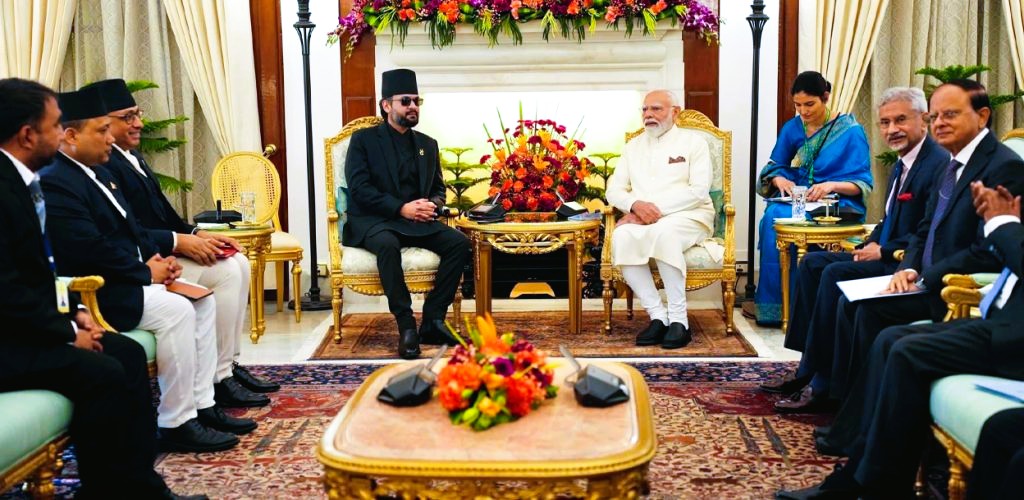
Nepal and India have reached two key agreements during a two day visit to India by Nepal’s Prime Minister Balen Shah. India will provide Rs 240 billion in aid, and the countries have agreed to establish two way international flights via Bhairahawa.
The agreements support Nepal’s efforts to secure funding for development and improve international connections from regional airports.
The aid package was agreed during talks between Prime Ministers Shah and Narendra Modi. It includes Rs 56 billion in grants and Rs 184 billion in concessional loans.
Grants and Loans
The package includes grants for recovery after flooding in Bhotekoshi.
However, the funding figures in the announcement are unclear. It states that Rs 56 billion will be provided in grants, then lists Rs 35 billion as grant funding and Rs 115 billion as concessional loans, with both figures also described as equivalent to Rs 184 billion in Nepali currency.
The package is part of the Rs 240 billion in economic aid announced by Indian Prime Minister Narendra Modi.
Nepal had requested 100 billion Indian rupees in grants and another 100 billion Indian rupees in loans. The final statement sets out a different split between grants and loans.
The aid will support reconstruction and development in Nepal. Since the package includes both grants and loans, it is not entirely grant funding.
Two Way Flights via Bhairahawa
During the visit, India approved two way flights on route B345, connecting Kathmandu, Bhairahawa, and Lucknow.
The route currently operates in one direction. Both countries have agreed to allow international flights in both directions.
Technical consultations will determine how to implement the agreement. The countries will also discuss other proposed civil aviation projects.
The decision follows years of efforts by Nepal to secure better access to international destinations through Indian airspace.
Boost for Bhairahawa International Airport
Nepal has long argued that opening more routes through India would help make better use of Bhairahawa International Airport (Gautam Buddha) and Pokhara International Airport.
Limited international air routes have made it difficult for airlines to expand services from regional airports.
Two way flights via Bhairahawa could make it easier for international airlines to serve the airport. This may strengthen its competitive position and support tourism and related industries in the area.
However, it is not yet clear when additional flights will begin. Technical consultations must be completed before the route can be implemented.
Proposed Route to Bagdogra
India has also requested permission to use Nepalese airspace to serve Bagdogra Airport.
As part of broader aviation discussions, the two countries will hold technical consultations on proposals from both sides.
Nepalese prime ministers have raised this issue during previous visits, but the countries have not yet reached an agreement.
The new agreement on two way flights via Bhairahawa is a positive development for Nepal’s aviation industry.
Key Outcomes of the Visit
Nepal and India have agreed to collaborate in two key areas.
The aid will support reconstruction and development, while improved air links could help Nepal make better use of its international airports.
Next steps include arranging the concessional loans and completing the technical processes needed to launch the two-way flight service via Bhairahawa.