
Victims of the Bhotekoshi flood have complained that they have still not received relief from the state.
They say that sufficient relief and assistance have not been provided even 50 days after the flood.
Nurpu Tamang, a local Kami from Timure, Rasuwa, said they are uncertain because the government has failed to present a clear plan.
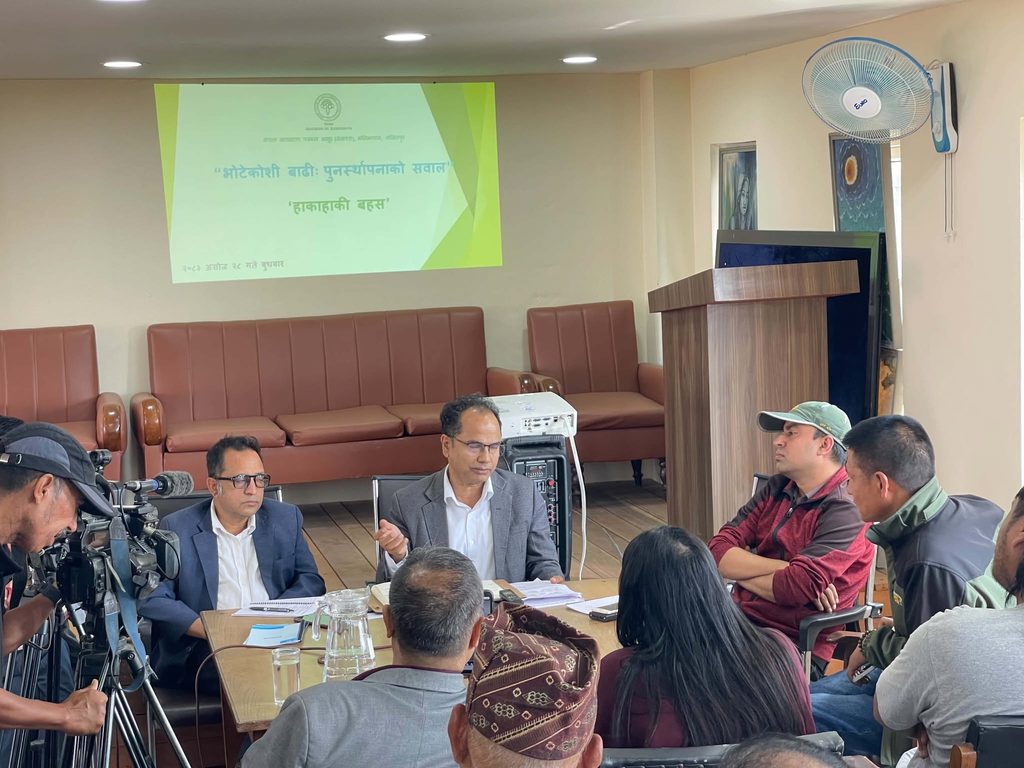
During a heated debate on ‘Bhotekoshi Flood: The Question of Rehabilitation’ organized by the Nepal Environmental Journalists Group on Wednesday, he said, ‘Permanent shelter should be provided as soon as possible. Safe locations should be identified to rehabilitate people affected by the flood.’
Tamang proposes that the actual cause of the floods be determined before the snowfall, permanent housing arrangements be made to reduce the loss of life and property in the coming days, and the government promptly bring the Rasuwagadhi border checkpoint and other trading centers into operation.
However, other local residents also complain that the state is not interested in such efforts.
Temporary housing for those affected within 6 months
Meanwhile, the Bhotekoshi flood victims will be relocated to temporary housing structures within six months.
According to preliminary data on 5,116 victims from Rasuwa, Nuwakot, Gorkha and Dhading who were affected by the flood of last 10 Bhadra, temporary structures will be built and housing arrangements made before permanent residences are provided, said Dr. Gharmaraj Upreti, Chief Executive Officer of the National Disaster Risk Reduction and Management Authority.
He said efforts are underway to construct permanent structures and relocate the flood-affected people within three years.
“The affected people will live in temporary structures until permanent ones are built, and we are preparing to construct those structures. Instead of constructing elaborate structures, we are focusing on safe ones,” he said.
The government has said it has adopted a policy of avoiding the establishment of settlements in flood-affected areas, given the medium level of potential flood risk.
The Survey Department is reportedly conducting land assessment work for the rehabilitation of those affected. Upreti said that preparations for rehabilitation are advancing in coordination with 24 different bodies, including the Authority.
The government has also decided to provide flood-affected people with a monthly allowance of Rs 15,000 per family of four.
Families with more than four members will receive an additional Rs 2,000 for each extra person, and this provision has been set for the next five months. Dr. Upreti said, ‘The process of providing financial assistance of Rs 45,000 to the affected families for the next three months has also begun.’
Speaking at the program, Prof. Dr. Sanjay Upreti of the Department of Architecture, Institute of Engineering, Pulchowk, suggested that the rehabilitation process should consider not only disaster and engineering concerns but also social, economic and cultural factors.
He urged authorities to advance housing plans in consultation with the victims, since maps prepared in an office do not reflect local life or align with the victims’ traditions and culture.
Speaking at the program, local flood-affected residents complained that the state had neglected to manage funeral expenses in accordance with local religious and cultural practices.
They also said that although the Buddhist community is expected to conduct the final rites for 49 days, the government has not provided any money for funeral expenses so far, and they no longer require it.
Chhedin Dolma, a local resident of Timure, Rasuwa, said they had not yet recovered from the psychological trauma caused by the flood. Likewise, locals Namgyal Ghale and Phurbu Dorje Ghale asked, ‘Where will we go now?’ Phurbu Dorje is the principal of Nepal National Basic School in Timure.
He is concerned about the future of his school and the area’s educational environment, as 10 students from the school went missing in the flood and the building no longer exists.
In Timure alone, Rasuwa, two-thirds of the local population, totaling 148 people, have disappeared because of the flood. Among them, 48 children have been orphaned.
Most locals affected by the flood have sought shelter in Kathmandu. Rasuwa-based journalist Nirajan Poudel said he had lost 50 family members, including his parents, and had received no relief even 50 days after the flood.
He urged that post-flood rehabilitation address social aspects as well as infrastructure, including employment, education, and health.
Nimesh Regmi, chairperson of the Nepal Environmental Journalists Group, which organized the program, said it was held to inform ordinary citizens suffering after the floods about the need to begin rehabilitation as soon as possible.
He stressed that the government’s rehabilitation policies, plans, and programs should be implemented without delay.[Source : NEFEJ]