
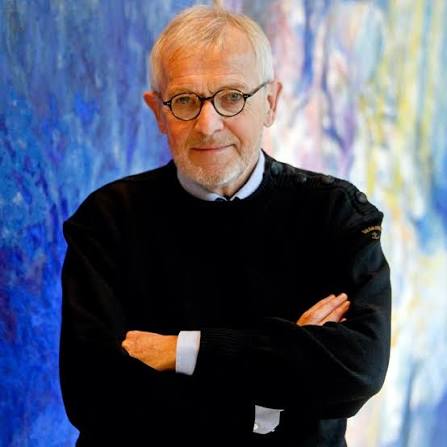
The 2026 Nobel Prize in Physics has been awarded by the Royal Swedish Academy of Sciences to Francis Halzen, a particle physicist of Belgian-American background. He received the honor for his key contribution to the IceCube Neutrino Observatory in Antarctica and for the pioneering detection of high-energy neutrinos originating from space.
Francis Halzen, a professor at the University of Wisconsin-Madison, is due to receive a prize sum of 12 million Swedish kroner (roughly $1.15 million).
How the IceCube Neutrino Observatory Managed to Detect “Ghost Particles”
Known as “ghost particles,” neutrinos can pass through practically any material. A concept put forward by the particle physics theorist made it possible to detect these nearly undetectable neutrinos.
The IceCube Neutrino Observatory, devised by Halzen, is made up of many thousands of optical sensors. It employs a cubic kilometer of clear ice surrounding the South Pole as a medium for tracing high-energy neutrinos arriving from space.
What High-Energy Neutrinos from Space Can Tell Us About the Origin of the Universe
Detecting astrophysical neutrinos matters for understanding where the universe came from. The neutrino physicist and his team set the foundation for upcoming discoveries about violent cosmic phenomena such as blazars and supermassive black holes.
Capable of traveling vast distances, the high-energy neutrinos covered billions of light-years before being detected. The ability to detect these ghost particles opens up a new avenue for understanding the universe, since it supplements what optical and radio telescopes observe.
Why Halzen’s Work on High-Energy Neutrinos Was Celebrated
The Nobel committee emphasized Halzen’s decades of effort in particle physics and his work connecting astrophysics with neutrino physics. The discovery both deepened the understanding of neutrinos and opened a new window for studying the universe.
The IceCube Neutrino Observatory in Antarctica is regarded as an unprecedented undertaking that draws on the beauty of this remote and isolated location while also yielding new insights about the universe.