
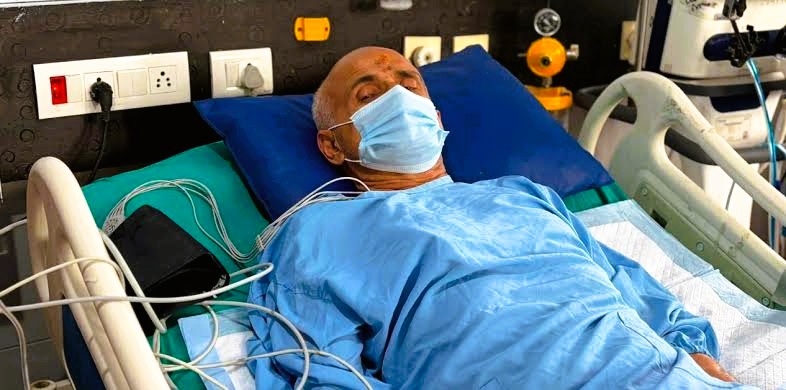
Medical education reform campaigner Dr Govinda KC says he will not hold talks with the four-member committee appointed by the government.
The government formed the panel after deciding to negotiate with KC over his demands. It is headed by Jayaram Adhikari, joint secretary at the Ministry of Education, Science and Technology, and includes officials from the Ministry of Health and Food Safety, the Medical Education Commission and the Education Ministry.
KC insists that negotiations should take place with a group of political leaders, saying he wants them to make the commitments.
Govinda KC rejects talks with government appointed panel
The government created the committee to negotiate with KC, who is now on his 25th hunger strike.
Led by Education Ministry Joint Secretary Jayaram Adhikari, the panel comprises representatives of the relevant government agencies.
KC, however, has declined to meet with the administrative committee. He wants to discuss his concerns directly with political leaders, putting pressure on the government to involve them.
Why does he want political leaders?
KC has voiced frustration over the government’s failure to carry out earlier agreements. He has repeatedly challenged decisions concerning medical education and health institutions.
He argues that assurances from government officials are insufficient unless political decision-makers are willing to take responsibility.
His latest position reflects concern that previous agreements have not been fully implemented. KC has previously cautioned that further talks could produce more promises without ensuring that existing commitments are honoured.
Six demands
KC has six demands relating to medical education, healthcare, appointments and good governance.
One is to revoke permission for Shaheed Dasharath Chand National Health Sciences University in Geta, Kailali, to run MBBS and nursing courses until the required infrastructure and human resources are in place.
He has also called for an impartial investigation into conflicts of interest involving appointments at the Medical Education Commission and universities.
Another key demand is to ensure that Geta Hospital is functioning properly before expanding medical education there.
KC has also called for the implementation of previous agreements and improvements to the quality of healthcare and medical education in the country.
Health concerns
KC began his 25th hunger strike in Ilam on October 29, calling for action on medical education and healthcare.
His health has since started to worsen, and doctors have advised moving him to a better-equipped hospital.
He was flown to Kathmandu on November 2 and admitted to Tribhuvan University Teaching Hospital.
As concerns about his health grew, medical professionals and civil society members called for immediate talks. The government then decided to form a committee to negotiate with him.
Will the government form a political team?
KC’s latest stance presents a fresh challenge for the government, which has already taken formal steps to establish a four-member committee.
Although the panel includes representatives from the relevant ministries and institutions, KC’s demand for political leaders to take part raises questions about the level of representation needed to reach an agreement.
The government must now decide whether to revise its approach and bring political leaders into the process.
Whether meaningful negotiations take place will depend on whether both sides can agree on how the talks should be conducted.