
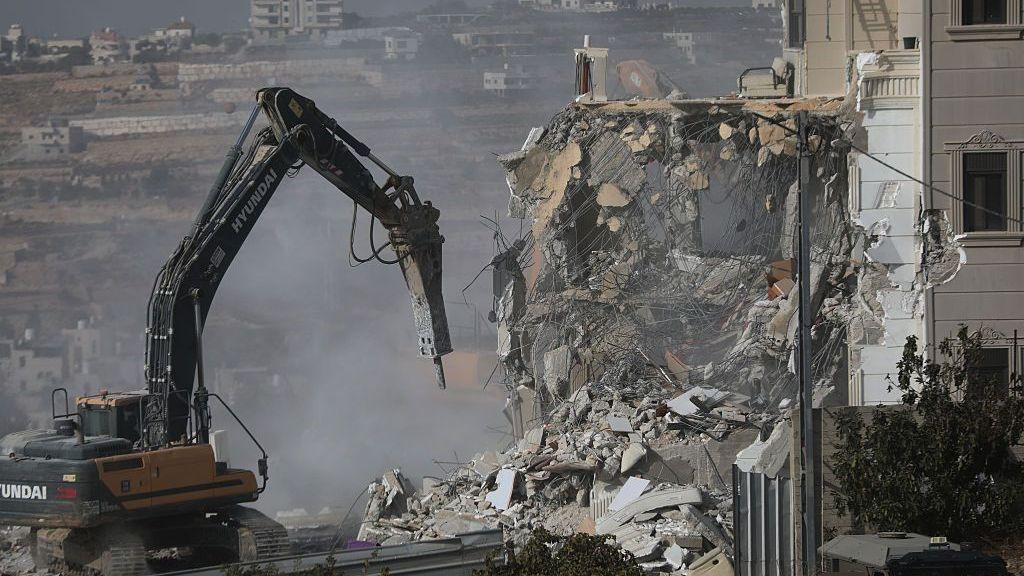
Israeli forces have begun demolishing Palestinian homes in Hebron following a shooting that resulted in the deaths of two Israeli soldiers and injuries to three others.
Demolitions commenced on Friday, October 23, just hours after the incident near a security checkpoint outside Hebron. Israeli Prime Minister Benjamin Netanyahu announced plans for a significant military operation in the West Bank and hinted at extensive security measures targeting the area where the attackers originated.
Bulldozers have been observed dismantling properties in close proximity to the shooting site.
A Palestinian news agency, WAFA, reported that a building with three apartments was demolished in northern Hebron, and access roads to the city were closed.
Two Israeli Soldiers Killed in Shooting Incident
The conflict ignited when two Palestinian shooters opened fire near a military checkpoint in Hebron, killing two Israeli soldiers and injuring three, according to the Israeli military.
Israeli troops subsequently killed the two attackers.
The military reported that the shooters were armed with an M16 rifle, a handgun, and a significant amount of ammunition, suggesting they may have intended a larger attack on Route 35 before being intercepted at the checkpoint.
This alleged plan has not been confirmed.
In response to the shooting, Israeli forces have increased their presence around Hebron and its surrounding areas.
Netanyahu Signals Broader Military Action
After evaluating the shooting scene, Netanyahu stated that Israeli forces would remove individuals linked to the attack, conduct door to door searches, confiscate weapons, and dismantle what he termed militant infrastructure.
He likened the anticipated Israeli response to past military operations in West Bank refugee camps, which involved extensive demolitions and the displacement of Palestinians.
Netanyahu revealed he had seen plans for one of Israel’s largest operations in the West Bank in recent years, although he did not specify a timeline for its initiation.
The Israeli government views its actions in Hebron as a direct response to the shooting and a measure to deter future attacks.
Palestinian Homes Demolished and Roads Closed
Israeli bulldozers began demolishing homes in Hebron on the afternoon of Friday, October 23.
WAFA reported that a house with three units owned by Palestinian resident Riyad Amrish was among those destroyed, serving as the family home.
Local Palestinians informed Reuters that the demolished buildings were unrelated to the attack. However, the Israeli military did not immediately respond to this claim.
The demolition operation was coupled with restrictions on the movement of people. Reports indicated that Israeli forces had surrounded the area and closed roads from Hebron to other regions, limiting the movement of Palestinians and vehicles.
The extent of the damage and the number of displaced families remains unclear.
Criticism of Demolition Policy
The policy of demolishing Palestinian homes in retaliation for attacks on Israelis has faced condemnation from numerous human rights organizations. Israeli authorities argue that such actions serve as a necessary deterrent against future attacks.
Conversely, Israeli rights groups and critics contend that this constitutes collective punishment.
In this instance, the Israeli actions followed Netanyahu’s prior warning to Palestinians about demolishing buildings in the area. Residents have denied any connection between their homes and the attackers.
The impact of these demolitions and the associated movement restrictions is significant for the people of Hebron.
Critics argue that responses should not involve the destruction of Palestinian homes and infrastructure.
Rising Tensions Ahead of Israeli Elections
The recent surge in violence occurred just days before the scheduled Israeli elections on October 27.
Netanyahu has prioritized security in his election campaign, asserting that his government will take all necessary measures to protect Israel. He canceled planned campaign events on Friday morning following the shooting.
The West Bank has seen a rise in violence recently, including assaults by Israeli settlers against Palestinian civilians during the olive harvest and attacks by Palestinian gunmen against Israeli soldiers and civilians.
The United Nations has reported casualties on both sides this year, highlighting the worsening security situation.
Potential for Further Escalation
Israeli forces continue to bolster their presence near Hebron, and roadblocks along with movement restrictions are heightening local tensions.
The Israeli government has cautioned that the conflict could escalate beyond Hebron, but the extent of potential fighting remains uncertain.
For Palestinians, the immediate outcome of the Israeli response may be the forced displacement of families due to home demolitions.
However, for Israeli authorities, the primary focus is preventing further attacks.