
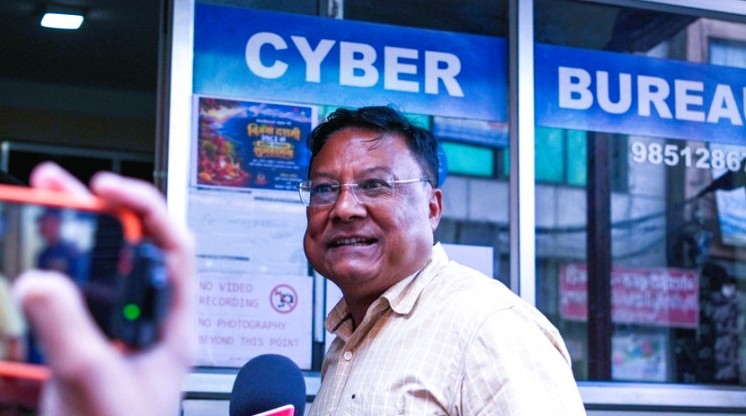
Journalist Kishor Shrestha was released on Saturday after political figure and artist Himesh Panta decided to bring his complaint regarding a news report about his family to the Press Council Nepal.
Himesh Panta, a leader of the Rastriya Swatantra Party (RSP), filed a cyber crime report against Kishor Shrestha, the chairman and editor of the weekly Jana Aastha, after a report claimed his family had taken over a neighbor’s 10 ropani land in Dhading district.
Shrestha was released following a meeting at the Nepal Police Cyber Bureau, where it was agreed to take the complaint to the Press Council Nepal, which manages media related complaints.
Both parties are free to proceed, as their complaints were filed with the Cyber Bureau, not the Press Council.
Rajendra Rimal, editor of Jana Aastha, stated that Panta agreed to take the complaint to the Press Council.
“The press council has the authority to determine if the complaint is valid,” Rimal noted.
Dipak Raj Awasthi, spokesperson for the Cyber Bureau, confirmed that both parties reached an agreement at the bureau.
Dispute Over News Report in Jana Aastha
The conflict began when Jana Aastha published a report about Himesh Panta’s family allegedly taking over a neighbor’s land.
Panta filed a cyber crime report against Shrestha, resulting in his arrest.
Shrestha then filed a counter complaint against Panta for negative comments made online. Both parties presented their complaints to the Cyber Bureau for resolution.
After his release, Shrestha clarified on social media that Panta had agreed to approach the Press Council Nepal if no resolution was found with his news outlet.
Shrestha argued that complaints about the news report should go to the Press Council, not the Cyber Crime Unit, and criticized the police for intervening in the media dispute.
Concerns About Criminal Cases Against Journalists
Shrestha’s arrest sparked backlash from journalists and media organizations, who felt the police were misusing cyber crime laws to undermine press freedom.
The Federation of Nepali Journalists FNJ condemned the police’s involvement and demanded Shrestha’s immediate release.
They emphasized that disputes over news reports should be handled by proper regulatory bodies, not law enforcement.
This incident has reignited discussions on the misuse of cyber crime laws and the police’s authority over journalists.
Critics have also raised concerns about Section 47 of the Electronic Transaction Act being used against publishers and journalists.
Shiva Gaunle, former FNJ president, labeled the case under Section 47 as a “misuse or misinterpretation of the law,” arguing it harms press freedom and strays from the law’s original purpose.
The FNJ also stated that police intervention in Shrestha’s case threatens the regulatory framework and press freedom.
Shrestha Was Previously Arrested
This marks the second time this year that Shrestha faced threats. On August 12, he was arrested over news coverage, and his residence and office were searched.
He was later released following Supreme Court intervention.
This case has intensified tensions between media outlets and individuals or companies who perceive them as offensive or misleading.
It has sparked a fresh debate on the appropriate authority to handle complaints related to news reports and journalists.
While the agreement allows Panta to take his complaint to the Press Council, it does not resolve the underlying dispute over the news report.
Shrestha’s team denies the allegations, asserting that the report about Panta’s family taking land is misleading and incorrect.
In contrast, Panta has labeled the report as “defamatory.” The disagreement continues, with both sides accusing each other of misrepresentation.
This situation underscores the need for a suitable regulatory mechanism that allows both parties to present their cases, with the Press Council taking necessary actions to resolve disputes without police involvement.