
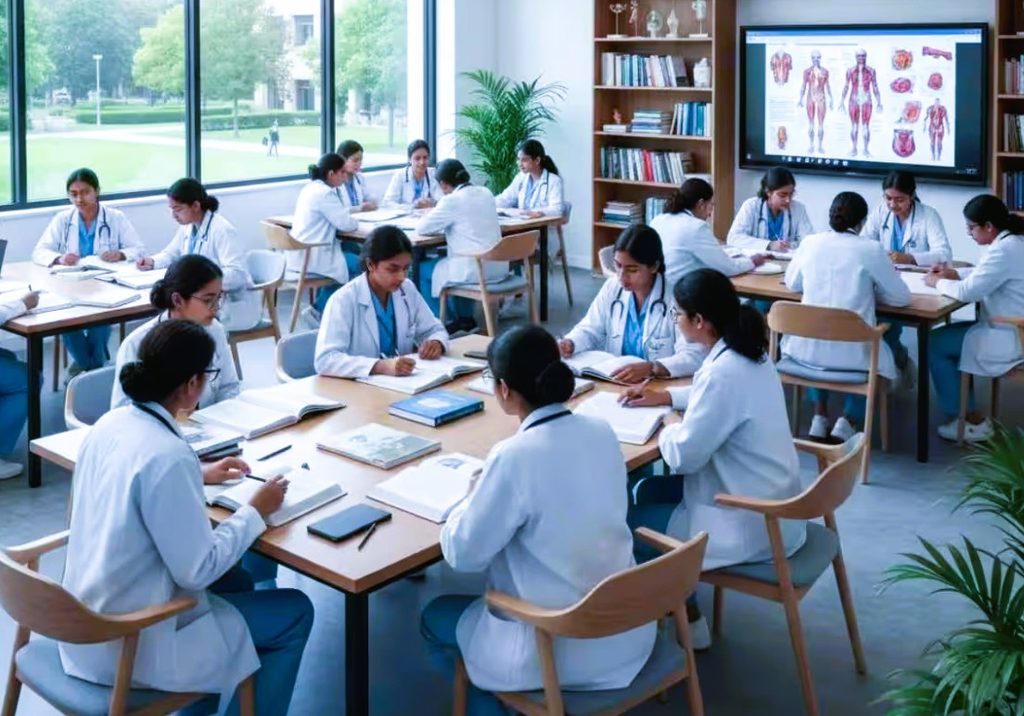
The government has approved 418 new seats for medical education programs for the 2026–27 academic year, including MBBS, BSc Nursing, and Bachelor of Medical Studies.
In the 28th meeting of the Medical Education Commission, led by Prime Minister Balendra Shah, a total of 9,691 seats have been allocated across 84 institutions offering various medical programs.
Among the new seats, 110 are designated for MBBS programs, while nursing and medical studies see the largest increases.
This year’s expansion focuses on government institutions, with private colleges maintaining their current seat allocations.
110 New MBBS Seats Approved
The MBBS program will see an increase of 110 seats compared to last year.
Shaheed Dasharath Chand University of Health Sciences in Geta, Kailali, has received 50 MBBS seats for the first time, enabling it to launch its undergraduate medical program.
B.P. Koirala Institute of Health Sciences (BPKIHS) in Dharan and the Nepalese Army Institute of Health Sciences each gained 30 additional MBBS seats.
The total increase of 110 MBBS seats includes 50 for the new university and 60 for the existing institutions.
These allocations aim to enhance medical education capacity at institutions equipped with the necessary infrastructure and staff.
Expansion in Nursing and Medical Studies Programs
BSc Nursing programs will see the largest increase, with 210 new seats approved for the upcoming academic year.
Additionally, 98 seats have been added to the Bachelor of Medical Studies program.
Combined with the 110 new MBBS seats, these increases total 418 new seats for the 2026–27 academic year.
This expansion supports programs that prepare students for various healthcare roles, including medicine and nursing.
While the number of available spots has increased, admission will still rely on entrance exams and eligibility criteria.
9,691 Seats Allocated Across 84 Institutions
The Medical Education Commission has allocated 9,691 seats across 84 institutions for the upcoming academic session.
This year, 90 educational institutions submitted self-assessment forms for seat allocations. After thorough monitoring, 84 institutions were approved.
Seat allocations are not granted solely based on requests; they consider infrastructure, faculty, and monitoring reports to ensure institutions can support the approved number of students.
Private Medical Colleges Maintain Current Allocations
Seat allocations at private medical colleges will remain unchanged for the new academic year.
A commission source noted that new seats have been approved at government institutions based on infrastructure and staffing evaluations.
This decision increases the total number of medical education seats while keeping private college intakes the same, emphasizing the importance of institutional capacity before expanding student enrollments.
Impact of the Increase on Medical Students
The additional 418 seats will enhance opportunities in specified medical education programs for the 2026–27 academic session.
The allocation of MBBS seats to Shaheed Dasharath Chand University of Health Sciences is particularly significant as it prepares to offer undergraduate medical education for the first time.
However, having approved seats does not guarantee enrollment; students must meet admission criteria and go through selection processes.
The commission’s decision outlines the capacity for the new academic year, while actual enrollment will depend on the admissions process.
This expansion marks a significant advancement in Nepal’s medical education planning, increasing capacity at selected government institutions and adding places in nursing and medical studies programs.