
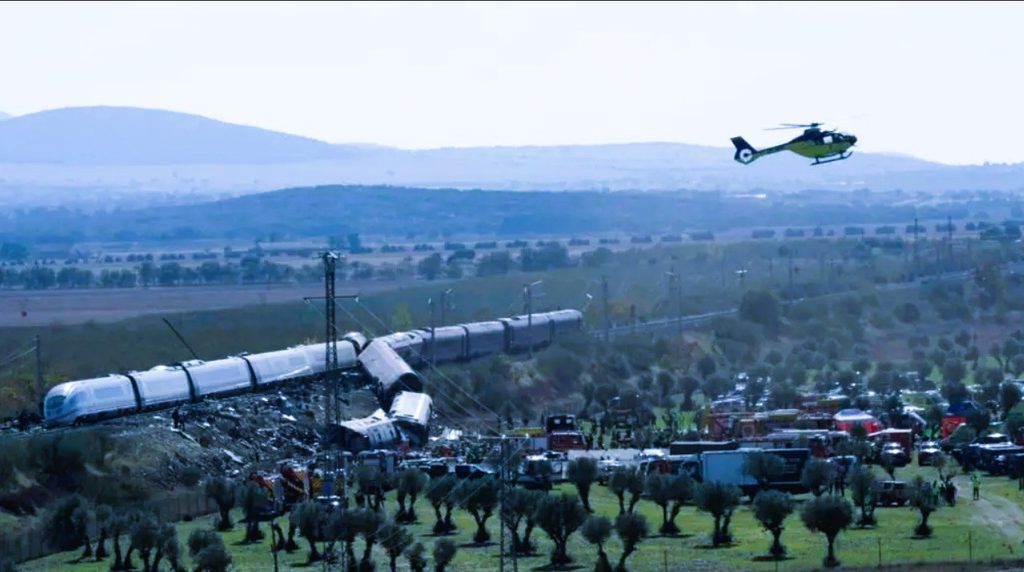
A high-speed train has struck a stationary train in central Spain, killing at least 68 people in one of the deadliest rail disasters in recent years.
The crash occurred on Wednesday, October 28, in Toledo province, close to Urda and Los Yébenes. Two carriages left the tracks and the wreckage was badly damaged. Officials said dozens of people had been injured, while emergency teams continued searching for survivors.
Two High Speed Trains Crash Near Toledo
Both passenger trains were travelling from Madrid to Seville, in southern Spain.
A RENFE train hit the rear of an IRYO train. The impact derailed two carriages and caused extensive damage.
Regional authorities said 68 or more people had died. Another 58 required hospital care. Hundreds of passengers were travelling on the two trains.
Train services linking Madrid, Ciudad Real and Andalusia have been suspended.
Rescue Teams Search the Wreckage for Survivors
Firefighters, police officers and medical teams reached the crash site soon after the collision.
Ambulances and medical helicopters transported injured passengers to nearby hospitals. Passengers who managed to escape from the wreckage were not seriously hurt.
People trapped in the two most heavily damaged carriages were in extremely serious condition, so rescue workers concentrated their efforts there. Local officials opened a sports pavilion in nearby Urda to receive injured passengers.
Witnesses described a powerful impact that sent objects flying inside the train. Some survivors had to escape through windows.
Transport Minister Cites Safety System Failure
Transport Minister Óscar Puente said the rail lines’ safety systems had failed.
A computer malfunction disabled safety systems along a 63-kilometre section, bringing trains in the area to a halt.
However, the central control centre instructed the RENFE train to keep moving without a speed limit. The collision occurred at about 8:53 a.m., despite a stop signal being active.
Puente said investigators were examining why this happened and how fast the train was travelling. Its speed may have reached 200 km/h.
More Than 300 Passengers Were on the Trains
Regional officials reported that 397 people were aboard the RENFE train and 147 were on the IRYO train.
The large number of passengers made the situation particularly serious. Hospitals treated the injured as emergency crews searched the damaged carriages.
IRYO said it had activated its safety procedures and was cooperating with the authorities. Spain’s military emergency brigade was also dispatched to support firefighters, police and other emergency services.
Prime Minister Pedro Sánchez cleared his schedule to focus on the disaster and expressed support for those affected. King Felipe VI and Queen Letizia also sent their condolences, as did European Commission President Ursula von der Leyen.
Spain Suffers a Second Deadly High-Speed Rail Crash
This is Spain’s second major fatal high-speed rail accident in 2026.
In January, a crash near Adamuz in southern Spain killed 46 people and injured more than 100. An IRYO train derailed and hit an oncoming RENFE train.
The incidents have heightened concerns about rail safety, signalling and train management. Spain has invested millions in its high-speed rail network, one of the largest in the world.
Although the network has long been viewed as a major Spanish infrastructure achievement, the two deadly crashes this year have prompted fresh questions about its safety.
Services Linking Madrid and Ciudad Real Suspended
Train services between Madrid, Ciudad Real and Andalusia have been stopped.
The Spanish Football Federation called off 24 Copa del Rey matches that were due to take place on Wednesday.
Investigators will examine the signalling systems, communications from the central control centre and the events leading up to the crash.
As emergency teams continue rescue and recovery work, authorities must identify those who died, assist everyone affected and establish how the collision occurred. Spain is mourning dozens of deaths while facing renewed concerns about the safety of its high-speed rail network.