
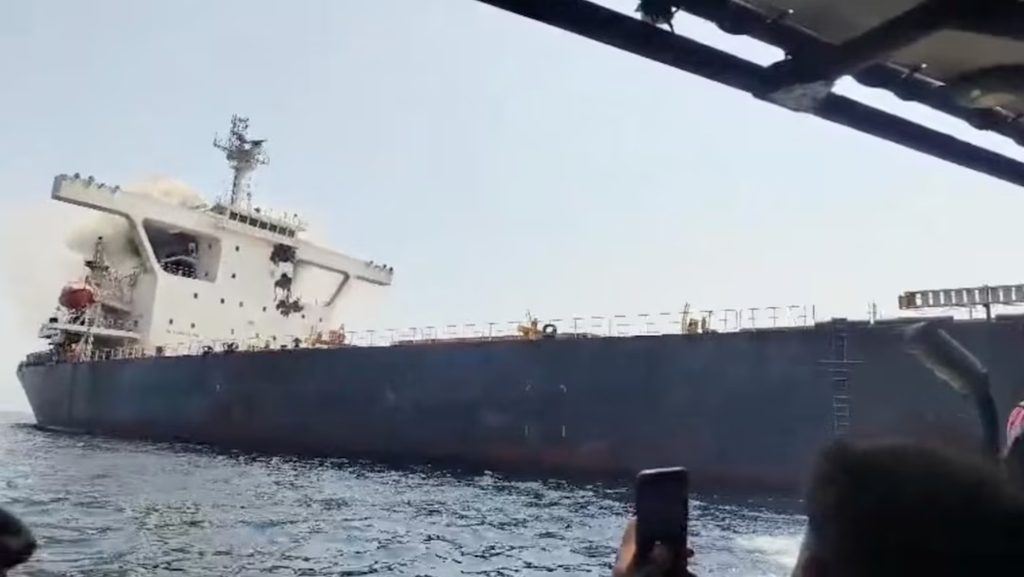
Two commercial ships have gone down near the strategically vital Strait of Hormuz amid a marked increase in attacks on shipping. The incidents have renewed concerns over maritime safety and possible effects on global trade.
Singapore’s Maritime and Port Authority said the Singapore registered container ship GFS Pride sank after a projectile struck it and it caught fire while transiting the strait on October 13. All 21 crew members were evacuated safely, and no injuries were reported.
In a separate case, the Antigua and Barbuda flagged dry bulk carrier Cape Dao also sank near the strait, weeks after a projectile hit it on September 23. One crew member died in that earlier attack; the remaining crew were evacuated.
The sinkings come amid a broader rise in attacks on commercial vessels in the region. The source of the projectiles involved in the individual incidents has not been conclusively determined.
GFS Pride Container Ship Catches Fire and Goes Down
The GFS Pride, a container ship with capacity for 2,824 twenty-foot equivalent units, was transiting the Strait of Hormuz when it was damaged and caught fire.
Singapore’s Maritime and Port Authority later confirmed that the vessel had sunk. All 21 crew members were evacuated, and authorities reported no injuries.
The maritime authority condemned further attacks on commercial vessels in the strait, calling them unjustifiable and contrary to international law.
The loss of the vessel underscores the growing risks faced by commercial ships in waters essential to energy supplies and trade.
Another Singapore Registered Vessel Sustains Damage
On October 14, the GFS Giselle, another Singapore registered container ship, was hit by unidentified projectiles while passing through the Strait of Hormuz.
The vessel’s hull was damaged, but it was able to reach a safe anchorage under its own power. All 22 crew members were reported safe, with no injuries.
Singapore’s maritime authority said it was communicating with the vessel’s management company and monitoring developments.
The strike on the GFS Giselle highlights the dangers ships face even when they are not sunk or disabled.
Attacks on Commercial Vessels Increase
The latest incidents follow a rise in attacks on commercial shipping over the past 10 days.
Iran has said it will intensify attacks in response to a US blockade of Iranian ports and tighter sanctions. Amid the wider conflict with the United States and Israel, it has also sought to strengthen its control over the Strait of Hormuz.
Oil tankers are no longer the only targets: container ships and bulk carriers have also been hit, putting a broader range of commercial vessels at risk.
However, responsibility for each projectile attack has not been independently confirmed. Maritime authorities are continuing to track the incidents and assess their effects on shipping.
The Strategic Importance of the Strait of Hormuz
The Strait of Hormuz connects the Persian Gulf to the Gulf of Oman and the Arabian Sea. Before the current war, around one ifth of global oil and liquefied natural gas trade passed through the strait, making it a key energy route.
Prolonged interruptions to shipping could affect schedules, freight charges, insurance premiums and the delivery of energy supplies to international markets.
Repeated attacks may prompt shipping companies to change routes, postpone voyages or adopt additional security measures. These responses can raise transportation costs and affect global energy markets.
The sinking of the GFS Pride and Cape Dao, along with the damage to the GFS Giselle, has intensified concerns about the safety of civilian vessels.
Maritime Security Risks Mount
The latest ship losses add to commercial shipping casualties since the US-Iran war began on February 28, 2026. A review of International Maritime Organization casualty data found that the GFS Pride and Cape Dao were the second and third vessels to sink since the conflict started.
Shipping companies and maritime security experts are increasingly concerned that attacks on different types of vessels could erode confidence in the route.
With tensions elevated and the origins of some attacks still unclear, the immediate priority is to protect crews and ensure commercial ships can travel safely.
Any further incidents could disrupt one of the world’s most important maritime trade corridors.