
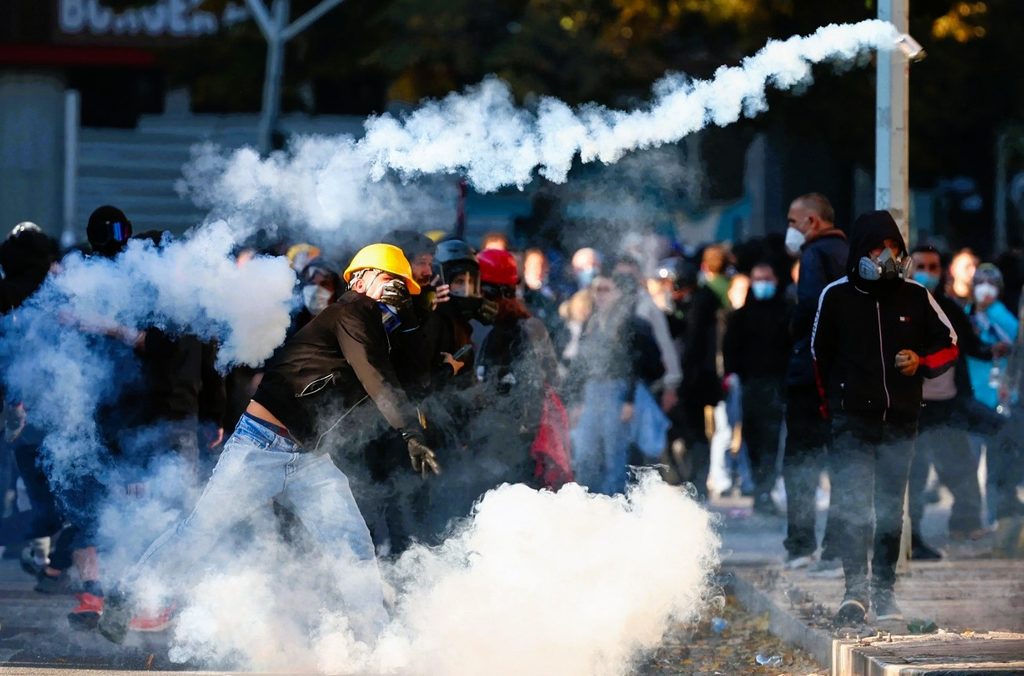
Albanian police used tear gas and water cannons to disperse demonstrators in Tirana after a week of violent protests against the government. Students and other protesters are demanding political change, improved education, and an end to corruption.
The protests involved high school and university students seeking better education, lower tuition fees, and increased government funding for schools. They joined others calling for an end to government corruption and the resignation of Prime Minister Edi Rama.
According to the Associated Press, during the clashes, protesters threw stones, flares, firebombs, and fireworks at police, who responded with tear gas, water cannons, and batons to push them back.
Students Join Larger Protests
The recent protests were fueled by student frustrations over education costs, government corruption, public spending, and high living expenses. Students are demanding an end to government spending on extravagant projects, more funding for education, and lower living costs. Their concerns reflect broader public dissatisfaction with the government.
Protesters expressed worries about high living costs making housing unaffordable and declining living standards, echoing sentiments heard in other European countries. The students’ demands aligned with the public’s call for government resignation, particularly criticizing Prime Minister Edi Rama.
Police Used Tear Gas and Water Cannons
Violent confrontations occurred in Tirana as police employed tear gas, water cannons, and batons against demonstrators. Protesters retaliated by throwing stones, flares, firebombs, and fireworks. Tensions escalated as protesters attempted to reach central Tirana.
Police used tear gas and water cannons to clear the streets, leading to increased public dissatisfaction as clashes continued. Prime Minister Rama condemned the unrest, stating that legitimate public concerns were being exploited to incite riots.
After meeting with teachers and representatives from Tirana’s schools and universities, Prime Minister Rama accused “provocateurs” of trying to destabilize the government through a “hybrid war.” He emphasized that legitimate issues regarding government spending, public expenses, and education would not justify riots.
Controversial Tourism Development Project
The recent protests were partly sparked by student anger over a proposed luxury resort on Albania’s southern coast. This project, opposed by environmental groups, is backed by an Israeli-American investment company owned by Jared Kushner, son in law of US president elect Donald Trump. The conflict between the government and environmentalists fits into a larger trend of public unrest.
Protesters pointed to corruption, government spending on projects like the Kushner development, and Edi Rama’s administration as key factors in Albania’s instability. Public discontent merged with student protests focused on education costs and government spending, highlighting concerns about corruption.
Prime Minister Rama accused his opponents of attempting to instigate a “hybrid war.” He criticized the use of public concerns regarding government spending, living costs, education, and housing to incite unrest and demand his resignation.
Albania Protests: Police Clash With Anti Government Demonstrators for Eighth Day
Albania’s current political unrest illustrates the challenges of addressing varied public concerns amid rising political instability. This wave of protests reflects a broader pattern of anti establishment sentiments across several European nations. As Albania aims to join the EU, maintaining domestic political stability is increasingly important.
For now, authorities in Tirana face the challenge of addressing public concerns. The duration of the protests may depend on the government’s willingness to negotiate and respond to demonstrators’ demands. Recent clashes signal growing public anger towards the government, fueled by the alignment of student demands with broader public concerns about spending, education costs, corruption, and economic decline.