
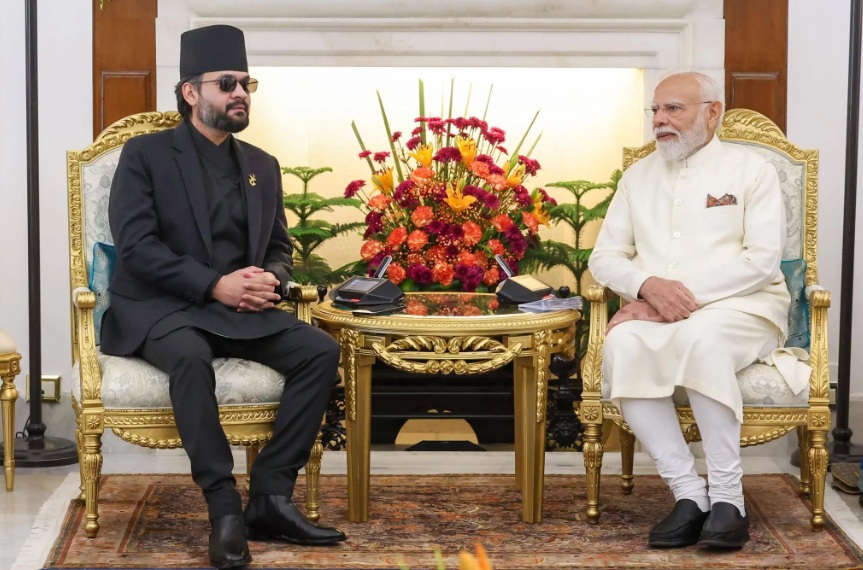
Nepal’s Prime Minister Balendra Shah and India’s Prime Minister Narendra Modi have announced new initiatives to strengthen relations between the two countries.
These include a 669 megawatt hydropower project and rail services connecting Janakpur and Ayodhya.
During Shah’s visit to India, the two prime ministers took part in events marking the launch of four projects and the inauguration of another.
The initiatives aim to expand energy and infrastructure cooperation and improve connectivity between Nepal and India.
Key announcements included the foundation stone for the Lower Arun Hydropower Project in Sankhuwasabha and the launch of the Janakpur–Ayodhya rail service.
Lower Arun Hydropower Project
The 669 megawatt Lower Arun Hydropower Project is located in Sankhuwasabha district. Its main structures will be in Chichila Rural Municipality and Khandbari Municipality.
SJVN Lower Arun Power Development Company, a subsidiary of India’s state owned Satluj Jal Vidyut Nigam, is developing the project.
The company estimates the construction cost at approximately Rs 92.67 billion and plans to complete the project within five years.
Under the project agreement, Nepal will receive 21% of the electricity generated free of cost. The agreement also requires the company to transfer ownership of the project to the Nepalese government free of cost after 25 years of commercial operation.
The project will boost Nepal’s electricity generation capacity and further strengthen energy cooperation between Nepal and India.
Janakpur–Ayodhya Rail Services
New rail services have been launched to improve connections between Janakpur Dham in Nepal and Ayodhya in India’s Uttar Pradesh state.
The route spans approximately 604 kilometres and links two important religious sites associated with the Ramayana tradition.
Janakpur is regarded as the birthplace of Sita, while Ayodhya is considered the birthplace of Lord Ram.
The service is expected to make travel easier for pilgrims, tourists and other passengers, while strengthening people to people ties across the region.
Trains will operate once a week in each direction. Train 15595 will depart Janakpur Dham on Saturdays at 1:10 p.m. and arrive at Ayodhya Cantt on Sundays at 8:10 a.m.
The return service, train 15596, will depart Ayodhya Cantt on Mondays at 5:50 p.m. and arrive at Janakpur Dham on Tuesdays at 12:40 p.m.
The trains will stop at several stations in Bihar and Uttar Pradesh, including Jaynagar, Madhubani, Sitamarhi, Raxaul, Narkatiaganj, Gorakhpur, Basti and Mankapur.
The rail link is expected to support religious tourism, improve cross border travel and create economic opportunities for communities along the route.
Infrastructure and Connectivity Improvements
The two countries also announced a series of infrastructure and connectivity initiatives.
Alongside the Lower Arun project, the plans include a petrochemical terminal in Jhapa, an integrated border checkpoint at Banbasa–Dodhara Chandani and an agro industrial park in Chitwan.
Nepal and India are also working together to improve cross border rail links, build petrochemical and gas pipelines, upgrade roads and trade infrastructure, and support broader development.
These improvements are expected to make trade easier and encourage economic growth in both countries.
Key Part of Shah’s Visit to India
The projects form a central part of Prime Minister Balendra Shah’s official visit to India.
Senior level talks focused on strengthening Nepal–India relations and expanding cooperation in areas of shared interest.
The announcements and inaugurations highlight both countries’ priorities: developing energy resources, improving regional connectivity, investing in infrastructure and deepening cultural ties.
Putting these projects into action will be essential to ensuring they deliver lasting benefits for people and businesses in Nepal and India.