
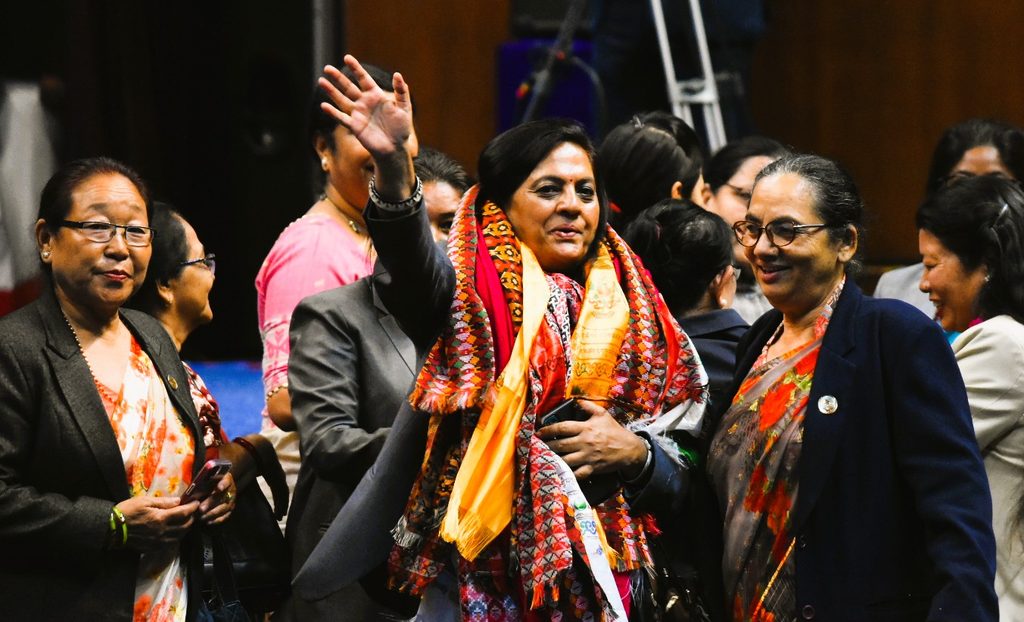
Pushpa Bhusal has become the first woman to hold the vice-president position in the Nepali Congress through the reserved women’s quota.
She was elected unopposed during the party’s 15th General Convention, as no other candidates filed nominations against her.
Bhusal will continue in the role she held during the party’s special general convention.
This election follows amendments to the party’s statutes, which now allow for positions reserved for women.
The new rules enable women to run for vice-president, general secretary, and joint general secretary in separate elections.
New Rules Enhance Women’s Representation
The amended statutes provide for five vice-presidents, including a senior vice-president, and create opportunities for women to contest key leadership roles.
These changes ensure that women make up at least one-third of the party’s 297-member Central Working Committee.
Previously, there was no separate contest for vice-president and general secretary roles for women.
While women could compete for leadership positions, the absence of reserved seats lacked institutional guarantees.
Nepali Congress President Gagan Thapa stated that these changes aim to empower women within the party.
The amendments have sparked discussions about the necessity of reserved seats within the mixed system.
Second Woman Vice-President of Nepali Congress
Bhusal is the second woman to serve as vice-president of the Nepali Congress, following Shailaja Acharya, who was appointed in 1996.
She initially became vice-president during the special general convention when the position was not reserved for women.
Her recent unopposed election is historic, marking the first time a woman holds the post through the new women’s quota.
Bhusal expressed surprise at the lack of competition, as she anticipated challengers.
A Long Political Journey
Born in Pokharathok, Arghakhanchi, Bhusal hails from a family with deep ties to the Nepali Congress.
Her father, Kashinath Gautam, was a Congress member and served as health minister in Nepal’s first democratically elected government in 1959.
Bhusal began her political career in 1971 and later joined the Nepal Students’ Union, the party’s student wing.
She has held various positions in the Nepal Women’s Association and other party sectors.
Bhusal joined the Nepali Congress Central Working Committee during the party’s 12th general convention and was a central member at the 13th and 14th conventions.
She participated in drafting Nepal’s Interim Constitution and was part of the Constitution Drafting Committee in the first Constituent Assembly.
In 2008, she was directly elected to the Constituent Assembly from Arghakhanchi-2.
She was elected to Parliament through proportional representation in 2017 and served as the Nepali Congress parliamentary whip from 2017-2022.
In July 2022, she was elected deputy speaker of the House of Representatives.
Bhusal has also worked as a lawyer and teacher, holding a bachelor’s degree in law and a master’s in political science.
A Milestone for Women’s Representation
Bhusal’s election marks a significant milestone for the Nepali Congress in enhancing women’s representation in decision-making roles.
The amended statutes pave the way for women to compete for leadership positions previously unavailable to them.
Supporters are optimistic that this initiative will strengthen women’s presence within the party.
The changes have also prompted discussions about the need for reserved seats in the mixed category.
Bhusal has committed to making the party more inclusive and addressing issues affecting women.
Her election through the women’s quota is a historic moment for the Nepali Congress, likely influencing the future of politics in Nepal.